“Humanizing online instruction means creating a sense of connectedness that has been noted in research studies as methods for engaging and retaining students”
Taleo, W. in Kilgore, W. (2016)
The common misunderstanding about online learning being “teacher-less” likely stems from the false belief that students may never see or hear the teacher.
Berge & Clark (2009)
“A systemic shift in pedagogy from the “content + discussion + assignment model” (Janssens-Bevernage, 2015) has yet to happen.”
DeWaard, H., in Kilgore, W. (2016)
“Perhaps the single most effective online classroom intervention for nontraditional students is to heighten the sense of the instructor’s presence in the course.”
Barnes, C. (2016)
Two main instructor roles: design and facilitation (Garrison et al. 2000.) We already talked about design, so now what about facilitation?
| Facilitation | Direct Instruction |
|
|
- Regular interaction with students and provide feedback (Berge and Clark 2009)
- Planned and spontaneous communication, and transparency
- Instructor as participant, facilitator, mentor (Burkle and Cleveland-Innes 2013)
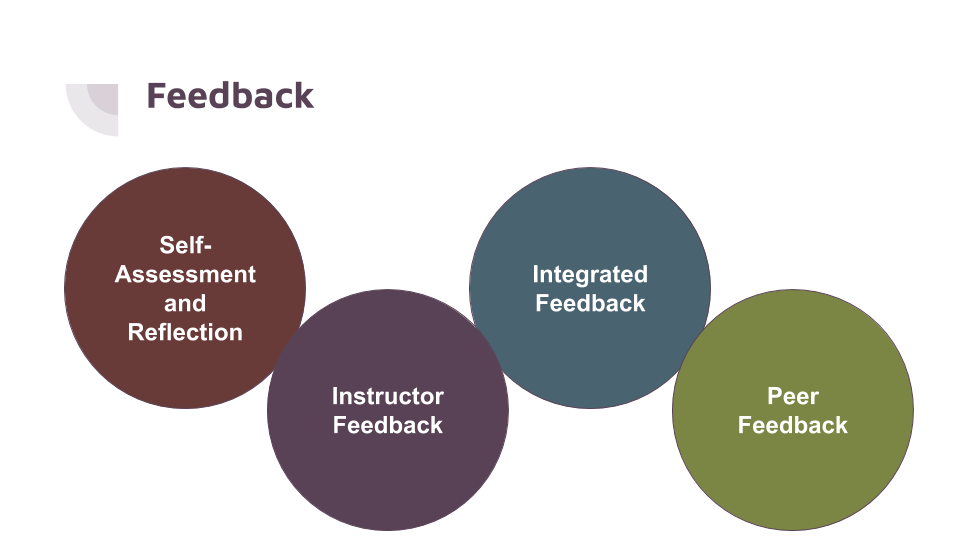
Feedback Planning

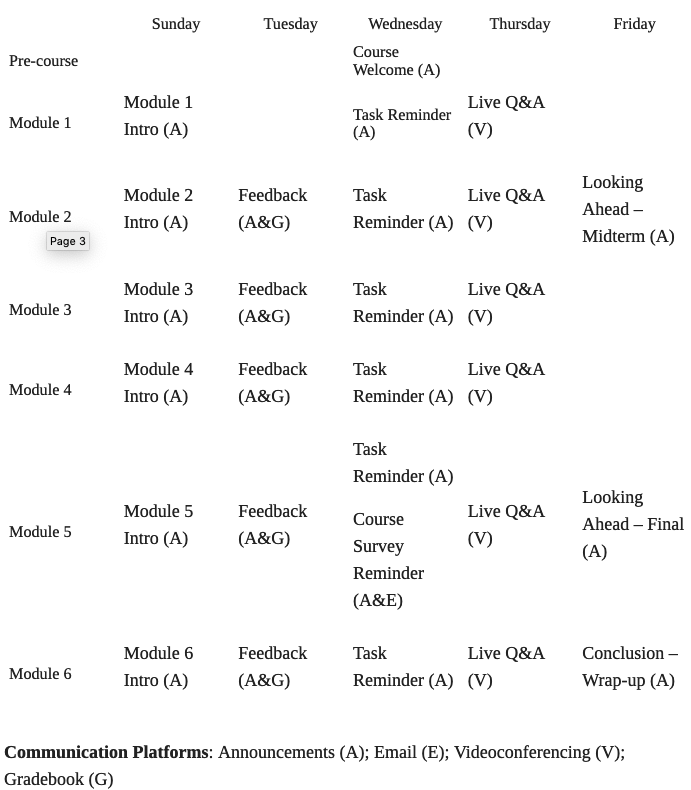
Communication Planning
 Think about any class you’ve taken or are teaching right now. How do you currently create a sense of connectedness? Which of the following is not included in your course currently, and how might they be incorporated?
- Communication Planning:
- proactive or reactive
- communication purpose, methods, frequency
- students contacting you
- in case of emergency break glass, or rather hierarchy of contact
- Feedback Planning
“I worked with two different Ph.D. supervisors. One of them was well able to convey his feedback clearly and supportively via text, whereas the other was much better able to express his feedback constructively in person, on the phone, or via Skype.”
Bali, M. in Kilgore, W. (2016)
Photo by Jonathan Borba on Unsplash
Photo by Brooke Cagle on Unsplash
Photo by Jonathan Borba on Unsplash
Photo by Christina @ wocintechchat.com on Unsplash
Photo by Irfan Raza on Unsplash
Photo by Sherise . on Unsplash
Photo by AllGo – An App For Plus Size People on Unsplash
Photo by André Noboa on Unsplash
Photo by Austin Distel on Unsplash
Sic Phase Feedback Model, by Helen DeWaard, CC-BY-SA 4.0
Communication Plan Sample, by iDesign, CC-BY-NC-SA 4.0