“Good design is crucial in education because much of the learning that students undertake is without direct supervision, meaning that learners only have designed instructions, artifacts, and scaffolding to guide their activity”
Bower, M. (2017)
“All instructional approaches require some components of direct instruction, if only to confirm that students understand the goals, instructions, and key points of the learning exercise.”
Gogia, L. (2019)
“The independent nature of [online] learning heightens the need for learners to have the tools to both initiate and manage their own learning. Moreover, as individuals engage with content, instructors, and fellow students exclusively online, an explicit focus on techniques meant to deepen the learning experience becomes increasingly important.”
Crosslin, M. (2018)
- Variety of content and activities
- Resources should be contextualized, and opportunities for feedback should be included throughout the course (Chakraborty & Nafukho, 2014)
- Relevance is key in adult learning, practical value of activities beyond the duration of the course establishes relevance (Knowles, 1984)
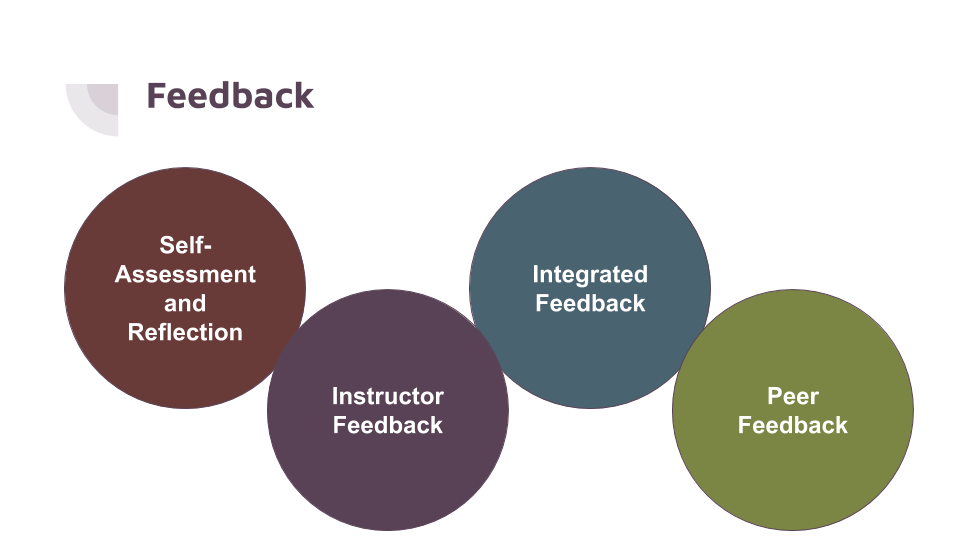
“Effective feedback isn’t a fix: it’s food, not medicine.”
Torcivia Prusko, P. (2020)
 Look through the content of your course and consider what you ask students to do independently. Then consider the following:
- How do you currently facilitate clear explanations and descriptions when information is not readily available from selected learning materials? Consider, for example, letting learners know why you want them to access these resources, and what they should be looking for.
- Where could you include reflection as part of project assignments? (e.g. on the process they went through , and how that process impacted their learning.)
- If you were to include reflection, how might it be continuous, connected, challenging, and contextualized? (Eyler, J., Giles, D.E. & Schmiede, A. 1996.)
- Where might students reflect on their own strategies for learning and behaviours? Crosslin (2018) provides a series of exercises one might try such as: The Multitasking Exercise, Journal Writing, Deep Reflection.
- Where in your course might you incorporate experiential learning, case studies, and problem-based activities designed to immerse learners in real world scenarios?
- Where might Self-Assessment fit into your course?
Photo by Bonnie Kittle on Unsplash