begin slide 1

The Doer Effect

Why would we want to make content interactive?

The “doer effect” is an association between the number of online interactive practice activities students’ do and their learning outcomes…evidence across four different courses involving over 12,500 students that the learning effect of doing is about six times greater than that of reading.Koedinger, K. R., McLaughlin, E. A., Jia, J. Z., & Bier, N. L. (2016, April).

What should I consider when making interactive content?

  • Management of Cognitive Load
  • Design Principles for engagement
    • chunking,
    • immediate feedback
    • presenting the information via a variety of methods and modalities, etc.
  • Active Learning
    • check your understanding,
    • guided activity

Bjork, R. A., Dunlosky, J., & Kornell, N. (2013). Self-regulated learning: Beliefs, techniques, and illusions. Annual review of psychology, 64, 417-444.

Koedinger, K. R., McLaughlin, E. A., Jia, J. Z., & Bier, N. L. (2016, April). Is the doer effect a causal relationship? How can we tell and why it’s important. In Proceedings of the Sixth International Conference on Learning Analytics & Knowledge (pp. 388-397).

Wilkie, S., Zakaria, G., McDonald, T., & Borland, R. (2018). Considerations for designing H5P online interactive activities. Open Oceans: Learning without borders. Proceedings ASCILITE, 543-549.


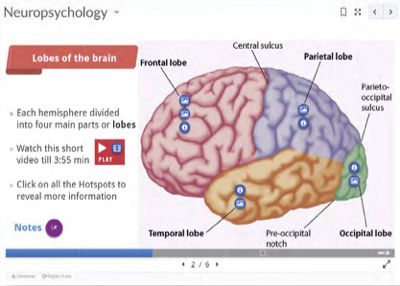
Brain Lobes Image used under a CC BY 4.0 License by Wilkie, S., Zakaria, G., McDonald, T., & Borland, R. (2018)
end slide 1

begin slide 2

H5P Overview

Free

H5P.org – A place for free trial so you can try things out.

Plugins available for WordPress, Drupal, and Moodle.

Paid

H5P.com – a paid version, no LMS needed.

Integrations via LTI with Canvas, Blackboard, and Moodle.

Attribution

end slide 2

begin slide 3

Interactive Video

Bookmarking Long Youtube Videos

Geology Videos

The following is part of GEOL109: The Earth and Life Through Time, Module 3: Plate Tectonics and Supercontinents. There are a number of videos in the course which include review questions throughout the video to provide students an opportunity to test their knowledge.

Making an Introduction Video

A resource for instructors which shows a great example of an intro video, with pop-up notes about the principles applied.

Understanding Plagiarism Video

end slide 3

begin slide 4

Accordion

Short Answer Check Your Understanding

If you wish to have students reflect on a question, perhaps even try to answer it, and then compare their solution with an expert answer then the accordion might be for you. This sample is a series of questions from:

GEOL109: The Earth and Life Through Time, Module 10: The Cenozoic Era- Paleocene to Pleistocene 

PLSC235: Urban Agrictulture 

end slide 4

begin slide 5

Dialogue and Flashcards

Flashcards for Learning

The dialog card has several different iterations available, one of which acts as a set of digital flashcards. The learner can shuffle, draw a selection, remove cards correctly guessed, etc. The designer can include text, audio, images, and hints for each card in a deck. This activity is from:

HORT27: Woody Landscape Plants, Module 4: Deciduous Trees.

ART 110: Art Today, Ideas and Practices

end slide 5

begin slide 6

Hotspots

Identifying Features in an Image

The following is an activity from:

GEOL108: The Earth and How it Works, Module 4: Igneous Rocks.

Identifying Multiple Features in an Image

ANTH111 Demo: One World Many Peoples Introduction to Cultural Anthropology

end slide 6

begin slide 7

Question Sets

Check Your Understanding and Formative Feedback

For a course that dealt with calculations, we can have students try their hand as solving problems without having to navigate away from the content. Using H5P they are able to get immediate feedback that is specific to the alternative they selected.

PHAR111: Pharmaceutical Calculations, Module 4: Expressions of Concentration


SOC112: Social Construction of Everyday Life

end slide 7

begin slide 8

Timeline

Drama 108: What is Theatre?

The following timeline is used as part of the course learning materials in Drama 108: What is Theatre?, Module 3: Evolution of Western Theatre

POLS 222: Indigenous Governance and Politics

The following timeline is used as part of the course learning materials in POLS 222: Indigenous Governance and Politics, Module 5: The Indian Act

end slide 8

begin slide 9

Drag and Drop

Organizing Information

Matching type questions are often used in place of drag and drop when this type of interactivity is not available. Drag and drop is a commonly requested interaction type, and has been used in elearning suites for decades. This activity is from GEOL109: The Earth and Life Through Time, Module 2: Geological Materials and Biogeochemical Cycles

Another example is from PHIL140: Critical Thinking. This time, a Truth table

Another example Tools for Online Teaching and Learning

end slide 9

begin slide 10

Other Notable Examples

This Judo Kata has 15 techniques which makes it difficult to scrub through the video and find exactly what you’re looking for. Bookmarks were placed so that a viewer can easily navigate to a specific technique for review.

Using H5Using H5P to Create Online SimulationsP to Create Online Simulations

via Laura Killam who made this in just under 3 hours.

Ryerson University Demo

H5P Demo

IS 201: Personality Quiz

end slide 10

begin slide 11

One Activity Many Approaches

When creating learning activities, H5P makes it easy to quickly prototype an idea to see which interactivity works best for your application.

ANTH 111: Design Features of Language Activity Demos

end slide 11

begin slide 12

The Ultimatum Game

We are going to play a game called The Ultimatum Game. For this game to work you will have to pretend to act as if this was a real simulation. Act as if there was real money on the table.

Part One

You are Player One. As Player One you are given the opportunity to choose how to divide $100 between you and Player Two. Imagine that there is $100 cash on the table and you (Participant One) are standing across the table form Player Two.

There is only one rule with regards to how you can distribute this money. You get to decide how much you and Player Two get out of the $100 but if Player Two rejects your offer neither of you get the money. For instance, if you decide to keep $90 and offer $10 to Player Two and she rejects this offer neither of you will get any money.

Based on this scenario, how much would you offer Player Two? Please select the amount you would offer Player Two. Remember to act as if this is $100 of real money. What would you actually offer Player Two?

Was your offer accepted? Why do you think that was the case? Why didn’t you offer the lowest possible amount of $1 to Player Two? Or did you? What does this result tell you about yourself or the human mind?

Part 2

Now that you have had the opportunity to play as Player One see how you would respond as Player Two. In the next scenario, Player One will make you an offer and you will have to decide to accept or decline the offer. Again, remember to act as you think you would if there was real money on the table. Please click on the button below to see how much Player One offers you. You now have an offer from Player One. What do you want to do? Will you accept or decline the offer?

Now that you have had the opportunity to play the game let’s take some time to reflect on the results.

For Part 1, as part of this experiment I put in a 30% acceptance threshold which turns out to be approximately the average of what is accepted when this experiment has been done with real money. See what you fellow students offered Player Two.

Note that if you are the first student to do this activity the poll will only have your result in it. If that is the case, I would suggest that you check in in a few days to give your fellow students the opportunity to do the activity as well.

end slide 12