begin slide 1

Learning Wayfinding

“Several of my professors put their assignments under this left column menu, but for another course I have to remember that the assignments are named differently and located under the top row pull-down menu taking multiple clicks to access. Why do I have to remember different paths to find the basics that I need to complete this course?”

Hill, P. (2019). Student Panels: Non-traditional students and consistency in course navigation.

Wayfinding, Finding Your Way, Wayfinding, Wayfinding

“Organization is one of the most important parts of an online course, and complicated course layout and poor navigation links contribute directly to learner confusion and a poor learning experience overall.” (Bristol and Zerwekh, 2011 in OLC)
Key Ingredients

  • Materials and activities are easy to locate and engage with. Navigation and wayfinding are clear.
  • Types of information and activities, as well as flow, is consistent throughout.
  • Styling of resources and materials are internally consistent and consistent with one another.

Layout and Structure

Key Ingredients
  • White-space and cutting out unnecessary information
  • Contrast
  • Typeface and Font
  • From Titles to Tables
Taste Test

Open up one of your online courses, a document you share with students, or a PowerPoint you use in class,

  • Read through the content in your course and take notice of where you think there should be more breaks.
  • Step back from your screen and look at your course pages. Squint your eyes and see if there is enough white space around the content.
  • Do a working memory check and read through your content. Note how much you can remember, and what did not stick.
  • Where have you used coloured text? Is it distracting? Is the contrast high enough?
  • Be consistent. If you change the colour of a heading, for example, be sure to reflect that in other headings in your course.
  • Avoid using multiple coloured text on one page, unless you intentionally want to highlight something.

Accessibility


Photo by Mitchell Luo on Unsplash

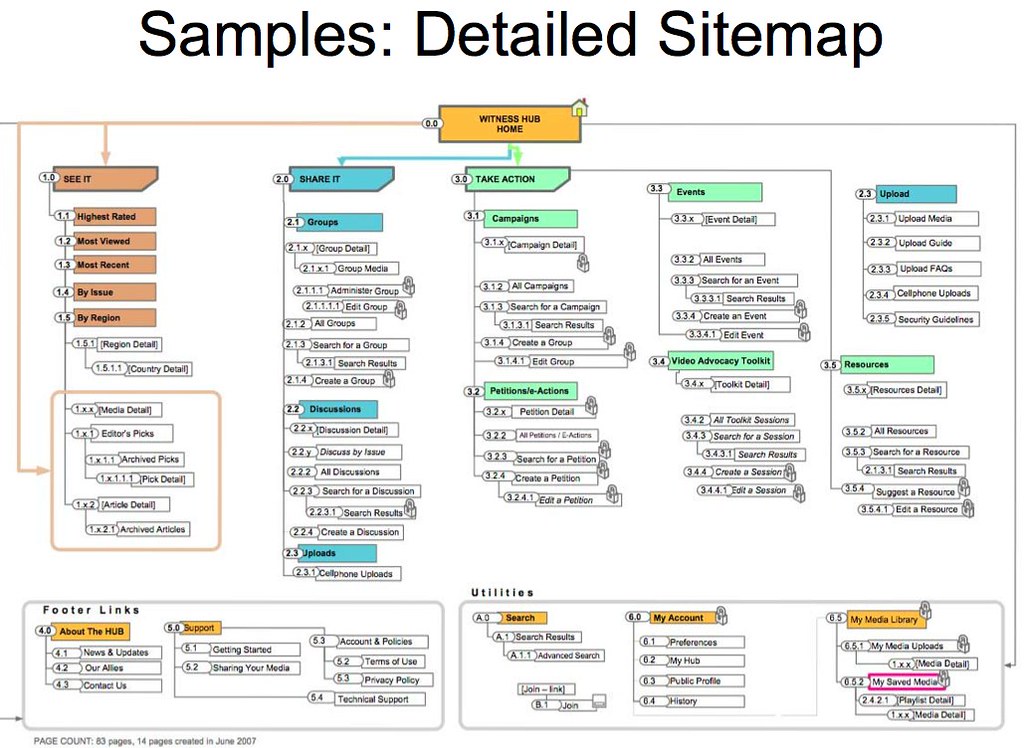
Detailed Sitemap (IA) flickr photo by kentbye shared under a Creative Commons (BY) license

Lorenzetti, J. P. (2008). 14 Ways Faculty Can Improve Online Student Retention. Recruitment & Retention in Higher Education, 22(12), 6-7.

end slide 1

begin slide 2

Instructifying Content

“Good design is crucial in education because much of the learning that students undertake is without direct supervision, meaning that learners only have designed instructions, artifacts, and scaffolding to guide their activity”

Bower, M. (2017)

“All instructional approaches require some components of direct instruction, if only to confirm that students understand the goals, instructions, and key points of the learning exercise.”

Gogia, L. (2019)

“The independent nature of [online] learning heightens the need for learners to have the tools to both initiate and manage their own learning. Moreover, as individuals engage with content, instructors, and fellow students exclusively online, an explicit focus on techniques meant to deepen the learning experience becomes increasingly important.”

Crosslin, M. (2018)

Key Ingredients
  • Variety of content and activities
  • Resources should be contextualized, and opportunities for feedback should be included throughout the course (Chakraborty & Nafukho, 2014)
  • Relevance is key in adult learning, practical value of activities beyond the duration of the course establishes relevance (Knowles, 1984)

“Effective feedback isn’t a fix: it’s food, not medicine.”

Torcivia Prusko, P. (2020)

Taste Test

Look through the content of your course and consider what you ask students to do independently. Then consider the following:

  • How do you currently facilitate clear explanations and descriptions when  information is not readily available from selected learning materials? Consider, for example, letting learners know why you want them to access these resources, and what they should be looking for.
  • Where could you include reflection as part of project assignments? (e.g. on the process they went through , and how that process impacted their learning.)
  • If you were to include reflection, how might it be continuous, connected, challenging, and contextualized? (Eyler, J., Giles, D.E. & Schmiede, A. 1996.)
  • Where might students reflect on their own strategies for learning and behaviours? Crosslin (2018) provides a series of exercises one might try such as: The Multitasking Exercise, Journal Writing, Deep Reflection.
  • Where in your course might you incorporate experiential learning, case studies, and problem-based activities designed to immerse learners in real world scenarios?
  • Where might Self-Assessment fit into your course?


Photo by Bonnie Kittle on Unsplash

end slide 2

begin slide 3

Humanizing Online Teaching

“Humanizing online instruction means creating a sense of connectedness that has been noted in research studies as methods for engaging and retaining students”

Taleo, W. in Kilgore, W. (2016)

The common misunderstanding about online learning being “teacher-less” likely stems from the false belief that students may never see or hear the teacher.

Berge & Clark (2009)

“A systemic shift in pedagogy from the “content + discussion + assignment model” (Janssens-Bevernage, 2015) has yet to happen.”

DeWaard, H., in Kilgore, W. (2016)

“Perhaps the single most effective online classroom intervention for nontraditional students is to heighten the sense of the instructor’s presence in the course.”

Barnes, C. (2016)

Two main instructor roles: design and facilitation (Garrison et al. 2000.) We already talked about design, so now what about facilitation?

Facilitation Direct Instruction
  • introductions
  • announcements
  • relating personal exp
  • timely and detailed feedback
  • online office hours or synchronous sessions
  • corrective and socratic
  • messages
  • tutorials
  • ungraded prompts
  • recorded lectures
  • written learning materials
  • examples
  • illustrations, etc.
  • demonstrations

Key Ingredients
  • Regular interaction with students and provide feedback (Berge and Clark 2009)
  • Planned and spontaneous communication, and transparency
  • Instructor as participant, facilitator, mentor (Burkle and Cleveland-Innes 2013)

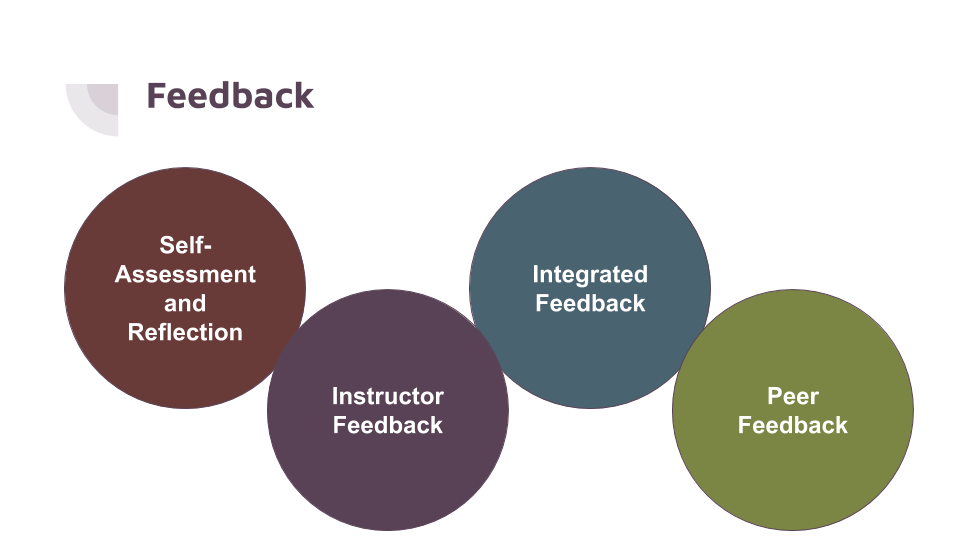
Feedback Planning

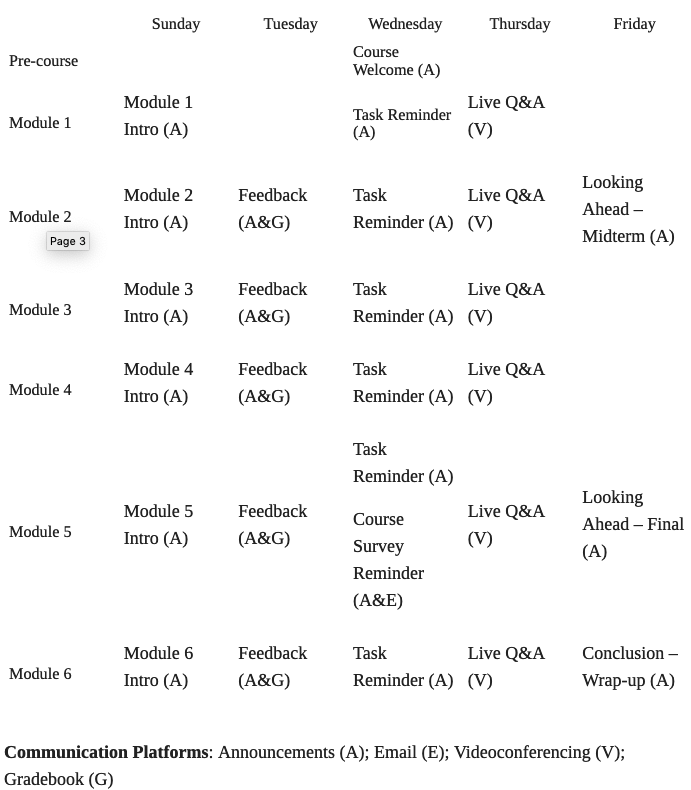
Communication Planning

Taste Test

Think about any class you’ve taken or are teaching right now. How do you currently create a sense of connectedness? Which of the following is not included in your course currently, and how might they be incorporated?

  • Communication Planning:
    • proactive or reactive
    • communication purpose, methods, frequency
    • students contacting you
    • in case of emergency break glass, or rather hierarchy of contact
  • Feedback Planning

“I worked with two different Ph.D. supervisors. One of them was well able to convey his feedback clearly and supportively via text, whereas the other was much better able to express his feedback constructively in person, on the phone, or via Skype.”

Bali, M. in Kilgore, W. (2016)


Photo by Jonathan Borba on Unsplash

Photo by Brooke Cagle on Unsplash

Photo by Jonathan Borba on Unsplash

Photo by Christina @ wocintechchat.com on Unsplash

Photo by Irfan Raza on Unsplash

Photo by Sherise . on Unsplash

Photo by AllGo – An App For Plus Size People on Unsplash

Photo by André Noboa on Unsplash

Photo by Austin Distel on Unsplash

Sic Phase Feedback Model, by Helen DeWaard, CC-BY-SA 4.0

Communication Plan Sample, by iDesign, CC-BY-NC-SA 4.0

end slide 3

begin slide 4

Socializing Online Learning

“A successful community of inquiry is an environment in which participants feel safe expressing their true thoughts and feelings, where they have a sense of social cohesion and they collaborate on shared projects.”

Spellman-Cann, S., Luong, E., Hendricks, C., Roberts, V. in Kiglore, W. (2016)

We can consider a shift in power from pedagogy to, “peeragogy…a flexible framework of techniques for peer learning and peer knowledge production…the way peers produce and utilize knowledge together”

(Rheingold et al., 2015)

Key Ingredients
  • Developing peer relationships increases student engagement and learning (Trowler, 2010)
  • Students are experienced and knowledgeable
  • Students can be contributors to the course itself
  • Students can be collaborators, learning with and from peers,
  • Social activities which focus on self-expression increase student agency.
  • Cognitive activities which focus on academic and professional goals engage students as a community.

Taste Test
  • Peer learning has many forms and mediums, not just group work or discussions.
  • Students as moderators, e.g. assign discussions forum each module, helping others stay on topic and track.
  • Host a formal debate.
  • Group work and presentations work in distributed and online environments too.
  • No one writes alone, consider how peer feedback might work for any project in your course.
  • Course wiki projects involve assigning individual learners to work on specific areas, creating a cohesive project. (e.g. Fedwiki; The Survey of Scottish Witchcraft – project)
  • Create scenarios for learners to interact in. Establish and assign roles for learners within those scenarios.
  • Have learners present a proposed project or research topic to the class to solicit feedback.
  • Create a simple weekly challenge to encourage creative thinking. For example, have learners share one related resource to the module topic, and share why it matters to them, and what value it brings to the course.
  • Use mini-cases where learners can see what might go wrong before they are actually immersed in a full scenario. (Caulfield business project)
  • Have learners create and facilitate course related scenarios.
  • Create “offline” activities and have the students “debrief” in “class”

Photo by Priscilla Du Preez on Unsplash

end slide 4

begin slide 5

Enjoy Your Creation!

end slide 5

begin slide 6

Reading and Stuff

Good Stuff

Crosslin, M. (2018). Creating Online Learning Experiences.

Gogia, L., Gaylen, K., Appleby, A., Meekins, D., Angell, H. (2019). The iDea Book.

Kilgore, W. (2016). Humanizing Online Teaching and Learning.

More Good Stuff

Berge, Z. & Clark, T. (2009). Virtual schools: What every education leader should know. White paper for the Virtual School Education Summit, Ft. Lauderdale, FL.

Bortone, L. (n.d.) 16 Types of videos you can create  http://www.magnoliamedianetwork.com/16-types-of-marekting-videos/

Burkle, M., & Cleveland-Innes, M. (2013). Defining the Role Adjustment Profile of Learners and Instructors Online. Journal of Asynchronous Learning Networks, 17(1), 73-87.

Chakraborty, M., & Nafukho, F. f. (2014). Strengthening student engagement: what do students want in online courses?. European Journal of Training & Development, 38(9), 782-802.

Cukusic, M., Garaca, Z., & Jadric, M. (2014). Online self-assessment and students’ success in higher education institutions. Computers & Education, 72, 100-109.

Dixson, M. d. (2012). Engaging the Online Learner: Activities and Resources for Creative Instruction, Updated Edition. NACTA Journal, 56(2), 99-100.

Eyler, J., Giles, D.E. & Schmiede, A. (1996) A practitioner’s guide to reflection in service-learning. Nashville: Vanderbilt University.

Garrison, D. R., Anderson, T., & Archer, W. (2000). Critical inquiry in a text-based environment: Computer conferencing in higher education. The Internet and Higher Education, 2(2), 87-105.

Garrison, D. R., Anderson, T., Archer, W. (2001). Critical thinking, cognitive presence, and computer conferencing in distance education. American Journal of Distance Education, 15(1).

Gioia, D. A. (1987). Contribution! Not participation in the OB classroom. Journal of Management Education, 11, 15-19.

Kelly, R. (2012). Managing Controversy in the Online Classroom. Online Classroom, 12(3), 2-3.

Knowles, M. (1984). The Adult Learner: A Neglected Species (3rd Ed.). Houston: Gulf Publishing.

Kolb, D. A., (1984), Experiential Learning: Experience as a Source of Learning and Development, Englewood Cliffs, Prentice-Hall

Kuh, G. D., Kinzie, J., Buckley, J. A., Bridges, B. K., & Hayek, J. C. (2008). What matters to student success: A review of the literature [Report]. National Postsecondary Education Cooperative.

Lee, Y., & Choi, J. (2011). A review of online course dropout research: implications for practice and future research. Educational Technology Research and Development, 59, 593-618.

Lee, S., Ngampornchai, A., Trail-Constant, T., Abril, A., & Srinivasan, S. (2016). Does a case-based online group project increase students’ satisfaction with interaction in online courses?. Active Learning In Higher Education, 17(3), 249-260.

Palloff, R. & Pratt, K. (2007). Building Online Learning Communities: Effective Strategies for the Virtual Classroom. San Francisco, CA: Jossey-Bass.

Taras, M. (2010). Student self-assessment: Processes and consequences. Teaching in Higher Education, 15(2), 199-209.

Trowler, V. (2010). Student engagement literature review [Report]. The Higher Education Academy.

Wyatt, J. L. (2014). Engaging the Online Learner: Activities and Resources for Creative Instruction. Adult Learning, 25(2), 74-75.

Yalcin, A., & Kaw, A. (2011). Do Homework Grading Policies Affect Student Learning?. International Journal of Engineering Education, 27(6), 1333-1342.

end slide 6